What is a frozen shoulder?
A frozen shoulder is pain and stiffness in the shoulder joint itself. The shoulder loses range of movement in most directions. Many people first notice it at night, or when they reach behind their back or into a high cupboard.
It affects around 10% of people in their fifties, slightly more often women (Brealey et al., 2020). People with diabetes are about five times more likely to get a frozen shoulder (Zreik et al., 2016).
Why it starts in one shoulder and not another can't be said for sure.
Is it a frozen shoulder or something else?
A frozen shoulder can be clinically recognised during a physical examination. A typical sign is that the arm turns outward much less than on the other side, even when someone else moves it for you, while an X-ray looks normal (Brealey et al., 2020).
Other shoulder problems can feel similar but need a different approach (Lewis, 2015). That's why we start with a careful examination and base the plan on it.
Does a frozen shoulder go away on its own?
It usually gets better, but often not completely. For a long time people were told a frozen shoulder goes through three phases, freezing, frozen and thawing, and then recovers fully by itself. A review of the research found no clear evidence for that complete spontaneous recovery. Without treatment, movement improved somewhat over one to four years, but not fully, and most of the improvement came in an early stage (Wong et al., 2017).
Not everyone gets full, pain-free range of movement back (Lewis, 2015). So it's worth having your shoulder looked at early, instead of waiting for it to pass.
Frozen shoulder treatment: what helps?
In a review of 65 studies, a corticosteroid injection (an anti-inflammatory) into the shoulder joint gave the best short-term results for pain and movement in frozen shoulders under a year old. Adding simple home exercises and stretches may add benefit over the months after (Challoumas et al., 2020).
In practice that means two steps. First, try to calm the pain enough that you can sleep and use your arm more. Then build up range of movement step by step, within what the shoulder allows at that moment. The exercises change with how the shoulder is doing. Mind you, this process can take months. It sucks, but it's normal.
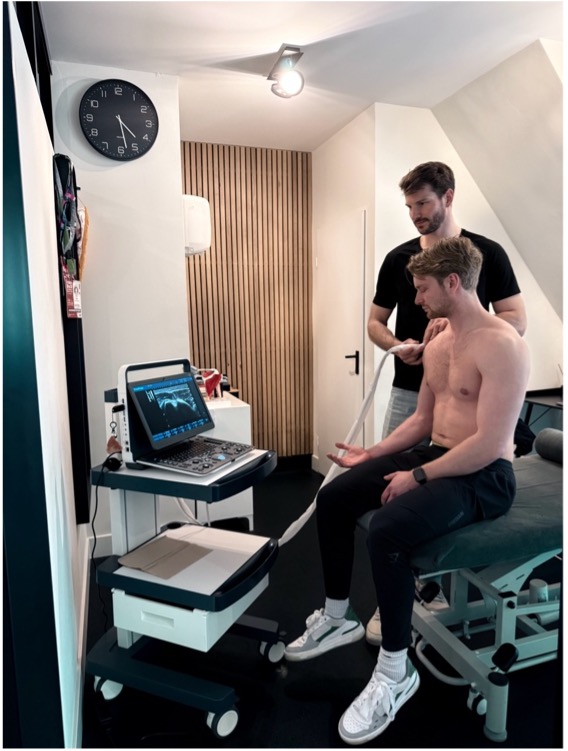
At EBP Studio we assess the shoulder, set up the exercise plan with you, and if an injection could help, we talk it through with you and your GP (huisarts) and refer accordingly through our professional network.
Do I need surgery or manipulation?
Usually not as a first step. A UK trial compared three options in 503 people with a frozen shoulder: physiotherapy with an injection, manipulation of the shoulder under anaesthesia, and keyhole surgery to release the joint capsule. After a year, none of the differences between them was large enough to count as important for patients. Serious complications were rare, and they occurred mainly in the surgery groups. Manipulation cost more than physiotherapy, but was judged the most cost-effective option. Keyhole surgery cost the most and carried the most risk (Brealey et al., 2020).
How long does a frozen shoulder take?
Think months, up to a couple years, rather than weeks. How long it takes differs a lot from person to person, so no one can give a fixed timeline. We check regularly whether the shoulder is moving in the right direction, and adjust the plan when it isn't.
When should you get your shoulder checked?
Make an appointment if:
- shoulder pain wakes you at night
- you can hardly lift or turn your arm
- nothing has changed after a few weeks
- you have diabetes and your shoulder is getting stiffer
See your GP if the symptoms started after a fall or a trauma, or if you also have a fever or feel unwell.
At a first appointment we talk through your complaints, examine how your shoulder moves, and explain what is likely going on and what isn't. You leave with a plan.
Already had treatment, or is surgery on the table? A second opinion can help you decide.
Frequently asked questions
Does an injection fix a frozen shoulder? It can calm the pain and showed positive short-term results in research. Adding home exercises may help further in the months after. An injection is most effective when done in an earlier phase (Challoumas et al., 2020).
Should I keep moving my shoulder if it hurts? Yes, within what the pain allows. Gentle movement and simple exercises are part of the treatment, and the plan is adjusted as the shoulder changes. Staying active in general, like walking or cycling, is good for you while the shoulder recovers.
Do I need a scan for a frozen shoulder? Usually not to diagnose it. That can usually be done from your symptoms and a physical examination. Sometimes certain scans are used to rule out other causes (Brealey et al., 2020).
References
- Challoumas D, Biddle M, McLean M, Millar NL. Comparison of treatments for frozen shoulder: a systematic review and meta-analysis. JAMA Netw Open. 2020;3(12):e2029581. doi.org/10.1001/jamanetworkopen.2020.29581
- Brealey S, Northgraves M, Kottam L, et al. Surgical treatments compared with early structured physiotherapy in secondary care for adults with primary frozen shoulder: the UK FROST three-arm RCT. Health Technol Assess. 2020;24(71):1-162. doi.org/10.3310/hta24710
- Wong CK, Levine WN, Deo K, et al. Natural history of frozen shoulder: fact or fiction? A systematic review. Physiotherapy. 2017;103(1):40-47. doi.org/10.1016/j.physio.2016.05.009
- Lewis J. Frozen shoulder contracture syndrome: aetiology, diagnosis and management. Man Ther. 2015;20(1):2-9. doi.org/10.1016/j.math.2014.07.006
- Zreik NH, Malik RA, Charalambous CP. Adhesive capsulitis of the shoulder and diabetes: a meta-analysis of prevalence. Muscles Ligaments Tendons J. 2016;6(1):26-34. doi.org/10.11138/mltj/2016.6.1.026
Reviewed by Thomas Mulder, physiotherapist MSc & Manual therapist MSc at EBP Studio.