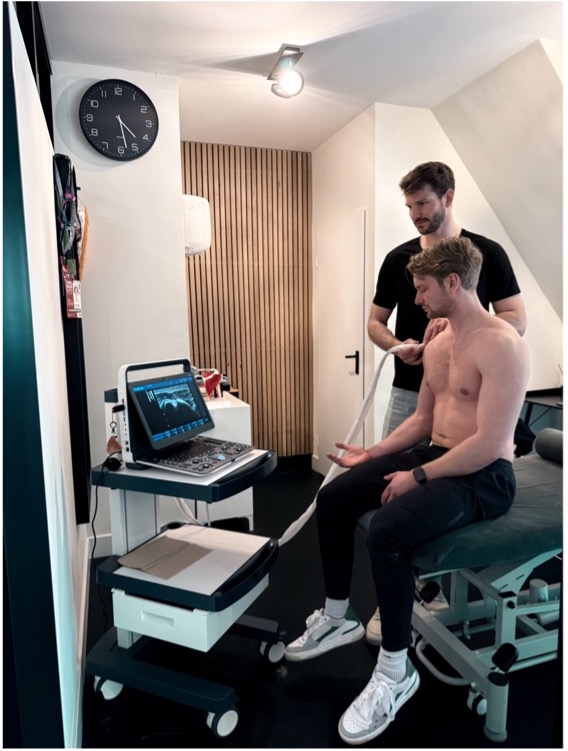
You have pain just below your kneecap. It flares when you jump, land, squat or come down the stairs, and it has not settled with rest. It is a frustrating spot to be in, especially if you have already stepped back from your sport and it still hurts.
In most cases the tendon below your kneecap has lost some of its capacity to handle (a certain type of) load. That can be rebuilt with the right approach.
What is a so-called jumper's knee, actually?
Jumper's knee is the everyday name for patellar tendinopathy, a load problem in the tendon that connects your kneecap to your shinbone. Despite how it feels, it is usually not an inflammation you can wait out by resting it. It is a tendon that can no longer handle the jumping, landing and deceleration you ask of it, and it lets you know with pain right at the tendon.
That distinction matters. "Damaged" sounds permanent. A tendon that is under-capacity can become stronger and more resilient again when you load it the right way.
Why does resting it often not fix it?
A tendon keeps its strength and capacity through (varied modalities of) load. Take that load away completely and both decrease. When you go back to your sport, the tendon is less prepared than before, and the pain comes back, often worse.
Rest feels like a sensible move. For this tendon it usually backfires.
This does not mean training through sharp pain. The heavy, spring-like loads, the jumping, cutting and deep landings, can come down for a while. Sitting completely still is rarely the answer.
What helps: building the tendon back up step by step
The core of recovery is progressive, dosed loading. You load the tendon heavily enough to challenge it and in a controlled enough way not to overload it, and you build from there.
One thing has become clear. No single exercise is magic, and the old habit of doing only slow eccentric squats on a decline board is not the whole answer. In a trial in patients with patellar tendinopathy, a full progressive-loading programme did better than eccentric-only exercise, and most of those patients had already tried other treatment without fully recovering. What matters is that the load fits the current state of your tendon and grows step by step.
People almost always ask whether activity is allowed to hurt, and whether loading will make it worse. Some pain during the exercises is fine, as long as it stays acceptable and settles within a day. Pain here does not mean you are causing damage. It is feedback on how much the tendon can handle right now.
But what if the scan showed damage/degeneration?
Many people arrive with an ultrasound or MRI showing changes in the tendon, and it worries them. That image says less than you would think.
A scan shows the structure of the tendon. It does not show your pain. People with no symptoms at all often show the same changes and remain active pain-free. And the tendon does not need to look better on the scan for you to feel better. In one study, how the tendon looked at the start did not predict who recovered. Changes on a scan do not mean your knee is beyond repair.
How long does jumper's knee take to settle?
How long recovery takes depends a lot on how long the pain has already been around. When the tendon has been bothering you for a while, this usually runs in months rather than days, and three to six months of steady rebuilding is common. It does not have to take that long, though. If the pain started recently, or came on after a clear spike in activity like a sudden jump in training, a new sport or a big one-off effort, it can settle a good deal faster once you adjust that activity and load the right way, sometimes within a few weeks. Either way, progress is usually gradual, and a clear plan and good guidance make the difference between sticking with it and giving up.
How do we approach jumper's knee at EBP Studio?
Many people who come to us have already rested, stretched or done exercises elsewhere without it fitting their situation. We start with the question underneath the complaint: where exactly is the capacity falling short, and how do we rebuild it while keeping you in as much of your activities/sport as we safely can? We build the plan around your knee, your sport and activities you love to get back to.
Still dealing with a knee that flares every time you jump or squat? Book an appointment and we'll look at where it is stuck and what it takes to move forward.
Frequently asked questions
Should I stop training with jumper's knee?
Full rest is usually not the answer. The tendon gets stronger through load and loses capacity when you take that load away entirely. You can bring the heaviest jumping and landing loads down for a while, but progressive exercises are part of the recovery.
How long does patellar tendinopathy take to recover?
Expect months rather than days. Three to six months of steady rebuilding is common, and longer-standing cases can take longer. Progress is usually gradual.
Does a scan tell me how bad my jumper's knee is?
Not really. A scan shows the tendon's structure, not your pain. The same changes show up in people without symptoms, and how the tendon looks does not reliably predict recovery.
This article is part of our guide to tendon pain.



.jpg)
.jpg)